One of the most common questions parents ask is: “Is my child on track?”
It is a simple question, but the answer matters deeply. Speech and language development are not just about talking. They are the foundation for learning, behavior, social relationships, and independence.
Understanding what is typical at each stage allows parents to recognize progress, identify potential concerns early, and seek support when needed.
This guide outlines evidence-based speech and language milestones from birth through 6 years, using information from trusted sources such as the American Speech-Language-Hearing Association and the Centers for Disease Control and Prevention.
What Are Speech and Language Milestones?
Speech and language milestones are skills that most children develop within a certain age range. These include:
- Receptive language: understanding words and directions
- Expressive language: using sounds, words, and sentences
- Social communication: interacting with others
- Speech clarity: how understandable a child’s speech is
Milestones are not rigid rules, but they are important indicators. Delays in these areas can signal the need for further evaluation or early intervention (ASHA, n.d.).
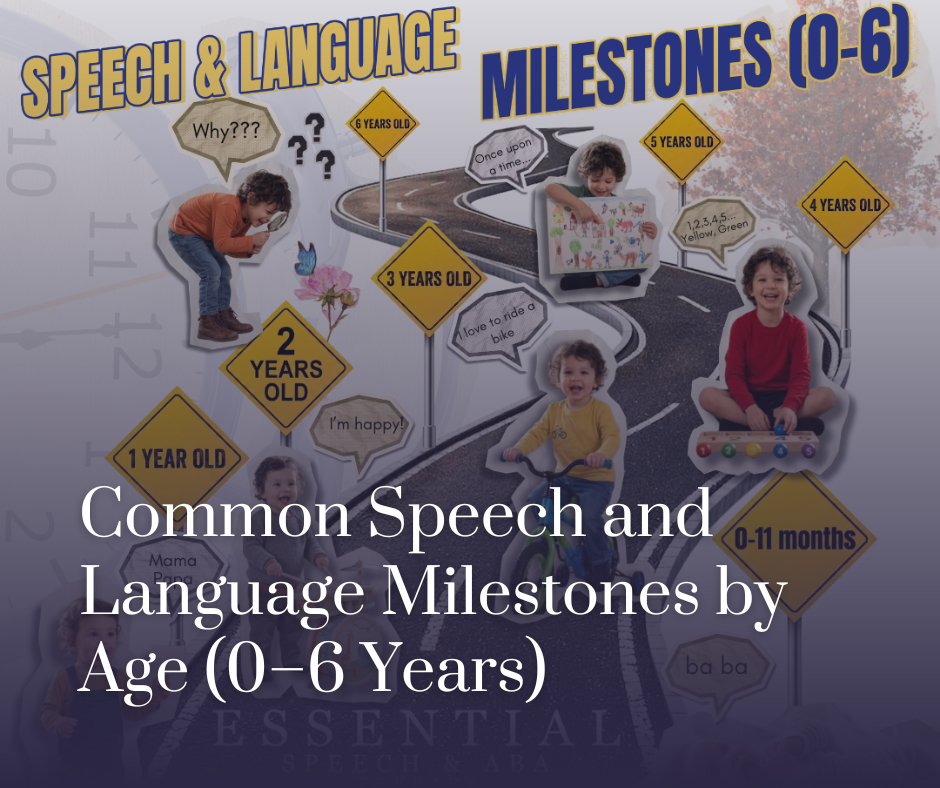
Birth to 6 Months: Building the Foundation
Even before babies say their first words, they are learning how communication works.
During this stage, you may notice:
- Startles or responds to sounds
- Recognizes caregiver voices
- Makes cooing sounds like “oo” and “ah”
- Smiles and engages socially
- Makes eye contact during interactions
These early interactions are critical. According to the CDC, responsive caregiving and back-and-forth interaction support early brain development and communication skills (CDC, 2023).
Practical tip: Talk, sing, and respond to your baby’s sounds. These “conversations” build the foundation for language.
6 to 12 Months: Intentional Communication Begins
At this stage, communication becomes more purposeful.
Children may:
- Respond to their name
- Understand simple words like “no” or “bye-bye”
- Use gestures such as pointing, reaching, or waving
- Babble with more varied sounds (e.g., “ba,” “da,” “ma”)
- Show interest in people and objects
Gestures like pointing are especially important. Research shows that gesture use is strongly linked to later language development (ASHA, n.d.).
Red flag to watch for: Limited eye contact, lack of babbling, or absence of gestures by 12 months.
12 to 18 Months: First Words Emerge
This is when many children begin using their first meaningful words.
Typical skills include:
- Saying first words (e.g., “mama,” “ball”)
- Using 10 to 20 words by around 18 months
- Following simple directions
- Pointing to show interest
- Imitating words and sounds
Vocabulary growth may seem slow at first, but it often accelerates quickly.
Practical tip: Label everything. Repetition and exposure help children connect words to meaning.
18 to 24 Months: Language Explosion
This stage is often referred to as a language burst.
Children may:
- Use at least 50 words
- Begin combining two words (e.g., “more milk,” “go outside”)
- Follow simple two-step directions
- Identify familiar objects and people
- Engage in simple pretend play
According to research, combining words is a key milestone that signals progress in grammar and language structure (ASHA, n.d.).
Red flag to watch for: Fewer than 50 words or no word combinations by age 2.
2 to 3 Years: Expanding Communication
Communication becomes more complex and interactive.
Children may:
- Use 2 to 3 word phrases consistently
- Have a vocabulary of 200+ words
- Ask simple questions (“What’s that?”)
- Be understood by familiar listeners most of the time
- Follow multi-step directions
At this stage, children begin using language for a variety of purposes including requesting, commenting, and asking questions.
Practical tip: Expand what your child says. If they say “dog,” you can say “big dog” or “the dog is running.”
3 to 4 Years: Building Conversations
Children begin to communicate more clearly and engage socially.
You may notice:
- Speaking in full sentences
- Telling simple stories
- Asking “why” questions
- Being understood by most people
- Using basic grammar (plurals, pronouns)
Speech clarity improves significantly during this stage. According to ASHA, unfamiliar listeners should understand most of what a child says by age 4 (ASHA, n.d.).
4 to 5 Years: Refining Language Skills
Children’s language becomes more detailed and structured.
They may:
- Tell longer, more detailed stories
- Use more complex sentences
- Understand and follow detailed instructions
- Answer questions about experiences
- Be understood clearly in most situations
Social communication skills also become more important as children interact with peers.
5 to 6 Years: School-Ready Communication
By this age, children should have strong foundational communication skills.
Typical abilities include:
- Speaking clearly and fluently
- Using correct grammar most of the time
- Understanding complex directions
- Participating in conversations and group settings
- Explaining ideas, events, and stories in detail
These skills are essential for school readiness, including reading, writing, and classroom participation.
When Should You Be Concerned?
While variation is normal, certain signs may indicate the need for further evaluation.
Consider seeking support if your child:
- Is not babbling or using gestures by 12 months
- Has no words by 16 months
- Is not combining words by age 2
- Has difficulty understanding language
- Is hard to understand compared to peers
- Shows limited interest in interaction
The CDC emphasizes that early action can make a significant difference in outcomes (CDC, 2023).
Why Early Identification Matters
Early identification allows children to access support during the most critical period of brain development.
Research shows that early intervention can:
- Improve communication outcomes
- Reduce frustration and behavioral challenges
- Support social and emotional development
- Increase long-term independence
Speech-language pathologists play a key role in assessing and treating communication delays, often working alongside other professionals to provide comprehensive care.
Practical Ways to Support Speech and Language at Home
Parents play a powerful role in development. Small, consistent interactions can have a big impact.
- Talk throughout your day and describe what you’re doing
- Read daily and ask simple questions about the story
- Follow your child’s interests during play
- Use simple, clear language
- Pause and give your child time to respond
- Limit passive screen time and prioritize interaction
These strategies are supported by research and recommended by ASHA as effective ways to promote language development (ASHA, n.d.).
Free, Reliable Handouts and Resources
If you want something tangible to reference, these trusted resources are excellent:
- ASHA Developmental Milestones (Birth to 5)
https://www.asha.org/public/developmental-milestones/communication-milestones/ - CDC “Learn the Signs. Act Early.” Milestone Checklists
https://www.cdc.gov/act-early/milestones/?CDC_AAref_Val=https://www.cdc.gov/ncbddd/actearly/milestones/index.html - CDC Milestone Tracker App (Free)
https://www.cdc.gov/act-early/milestones-app/?CDC_AAref_Val=https://www.cdc.gov/ncbddd/actearly/milestones-app.html - ASHA Identify the Signs (Speech, Language, Hearing)
https://identifythesigns.org - Zero to Three Early Development Resources
https://www.zerotothree.org
These resources are evidence-based, parent-friendly, and widely used across clinical settings.
Final Thoughts
Understanding speech and language milestones is not about comparing children or creating pressure. It is about awareness and empowerment.
When parents know what to look for, they can act early. And when they act early, children have the opportunity to receive the support they need during the most important years of development.
If you ever feel unsure, trust your instincts.
Seeking guidance early is one of the most impactful steps you can take for your child’s future.