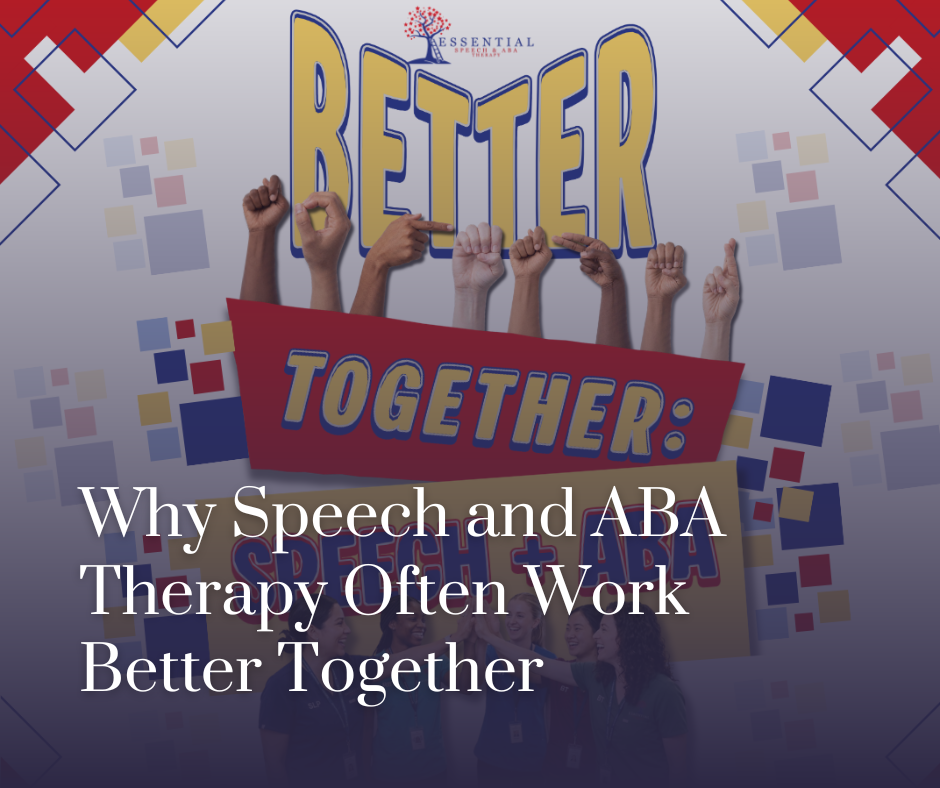
Families are often introduced to speech therapy and Applied Behavior Analysis (ABA) therapy separately. Each has its own goals, its own specialists, and its own approach.
But for many young children, especially those with autism or communication delays, the most meaningful progress does not happen in isolation. It happens when these therapies work together, intentionally and consistently.
This is where real change begins.
Grounded in research and best practices from the American Speech-Language-Hearing Association and the field of Applied Behavior Analysis, this article explains why a collaborative approach often leads to stronger, more functional outcomes.
Understanding the Difference First
Before understanding why these therapies work well together, it is important to understand what each one focuses on.
Speech Therapy Focuses on Communication
Speech-language pathologists (SLPs) work on:
- Understanding language
- Using words, gestures, or alternative communication
- Speech sound production
- Social communication
- Feeding and oral-motor skills
The goal is to help children communicate effectively and meaningfully.
ABA Therapy Focuses on Learning and Behavior
ABA therapy focuses on how children learn and interact with their environment.
It targets:
- Skill acquisition (communication, play, daily living)
- Behavior reduction (when behaviors interfere with learning)
- Attention and engagement
- Following directions and routines
The goal is to help children learn skills that improve independence and quality of life.
Where the Disconnect Happens
When these therapies are provided separately without coordination, families often notice:
- Different strategies being used for the same skill
- Lack of consistency across providers
- Slower progress than expected
- Confusion about what to prioritize
For example:
A child may be learning to say “more bubbles” in speech therapy with simple modeling and wait time. In ABA, they might be prompted to say “I want bubbles” or use a different system like pictures. Now the child is getting different expectations for the same skill. That inconsistency can slow progress and create frustration instead of confidence.
This lack of alignment can limit progress.
Why Integration Changes Everything
When speech therapy and ABA therapy are aligned, communication is no longer treated as a separate goal. It becomes part of every interaction throughout the child’s day.
This is where the shift happens.
1. Communication Is Practiced More Frequently
Speech therapy sessions may happen a few times per week.
ABA therapy, especially in early intervention models, often occurs for many hours per week.
When communication goals are embedded into ABA sessions:
- Children get hundreds of additional opportunities to practice
- Skills are reinforced in real time
- Learning becomes more natural and consistent
Why it matters: Repetition and consistency are key to skill acquisition (ABA principles).
2. Skills Become More Functional
In speech therapy, a child may learn to say “more” or “help.”
In a collaborative model, those same words are used:
- During play
- At snack time
- During transitions
- In moments of frustration
This helps children understand:
Communication is not just something we do in therapy. It is how we get our needs met.
3. Behavior Improves When Communication Improves
Many challenging behaviors are rooted in communication difficulties.
When a child cannot:
- Express what they want
- Ask for help
- Communicate discomfort
They may resort to:
- Crying
- Throwing
- Avoidance
When speech and ABA work together:
- Communication is taught as an alternative to behavior
- Children learn more effective ways to express themselves
- Frustration decreases
This is one of the most powerful outcomes of integrated care.
4. Consistency Across Providers
When teams collaborate, they align on:
- Language targets
- Prompting strategies
- Reinforcement methods
- Communication systems
This means the child experiences the same expectations and support across environments.
Consistency leads to faster learning and less confusion.
5. Faster Generalization of Skills
One of the biggest challenges in therapy is generalization.
A child may learn a skill in one setting but struggle to use it elsewhere.
When speech and ABA are integrated:
- Skills are practiced across multiple environments
- Different people reinforce the same goals
- Children learn to use communication more flexibly
This is critical for real-world success.
6. More Comprehensive Support
Speech therapy brings expertise in communication development.
ABA brings expertise in learning, behavior, and skill acquisition.
Together, they address:
- The how of communication (speech therapy)
- The when, why, and where of communication (ABA)
This combination creates a more complete picture of the child’s needs.
What Collaboration Actually Looks Like
Effective collaboration is not just two providers working in the same building.
It includes:
- Shared goals across disciplines
- Regular communication between therapists
- Coordinated strategies
- Parent involvement and training
In strong models, you may see:
- SLPs and BCBAs aligning on communication systems
- ABA therapists reinforcing speech goals throughout the day
- Joint problem-solving when progress stalls
A Practical Example
A child is learning to request help.
In speech therapy:
- The SLP models “help”
- Uses prompting and reinforcement
- Builds understanding of the word
In ABA therapy:
- The child is given multiple opportunities to request help
- Prompts are aligned with what the SLP is using
- The response is reinforced consistently
At home:
- Parents are coached to respond the same way
Now the child is not practicing “help” a few times a week.
They are practicing it dozens of times every day.
That is the difference.
Addressing a Common Concern
Some families worry that combining therapies may be overwhelming.
In reality, when done correctly:
- It feels more natural, not more intense
- Skills are embedded into play and daily routines
- The child is not switching between conflicting approaches
The goal is not to add more.
It is to align what is already happening.
When This Approach Is Most Beneficial
While collaboration benefits many children, it is especially impactful for:
- Children with autism
- Children with significant language delays
- Children who struggle with behavior related to communication
- Children in early intervention (typically under age 6)
Early, intensive, and collaborative care has been shown to improve long-term outcomes across communication and adaptive skills.
Final Thoughts
Speech therapy and ABA therapy are both powerful on their own.
But when they work together, something different happens:
- Communication becomes more consistent
- Learning becomes more meaningful
- Progress becomes more functional
And most importantly, children gain the ability to express themselves in ways that reduce frustration, increase independence, and improve their ability to connect with the world around them.