The Premack Principle, also known in the world of therapy and parenting as the “First/Then” rule, is one of the most effective tools in the behavioral toolbox. At its core, it’s a simple “grandma’s rule”: First eat your vegetables, then you can have dessert.
While it sounds straightforward, the psychology behind it is profound. For individuals with autism or executive functioning challenges, “First/Then” provides a visual and cognitive bridge between a low-motivation task and a high-motivation reward. Here is a deep dive into why it works, how to implement it, and the common pitfalls to avoid.
1. The Science: What is the Premack Principle?
Named after psychologist David Premack, the principle states that more probable behaviors will reinforce less probable behaviors. In simpler terms: if you want someone to do something they don’t particularly like (a “low-probability behavior”), you pair it with something they love (a “high-probability behavior”). The high-probability behavior acts as the natural reinforcer for the low-probability one.
For many of our adult brains, this happens internally. You might think, “If I finish this boring spreadsheet now, I can go grab a coffee.” However, for many children, and especially children on the autism spectrum, the ability to sequence future rewards or tolerate the “non-preferred” task is hampered by:
- Executive Dysfunction: Difficulty planning or seeing the “end” of a task.
- Monotropism: Intense focus on a single interest, making it painful to transition away from it.
- Anxiety: Not knowing when a stressful task will end.
“First/Then” solves this by externalizing the internal dialogue.
2. The Anatomy of a First/Then Board
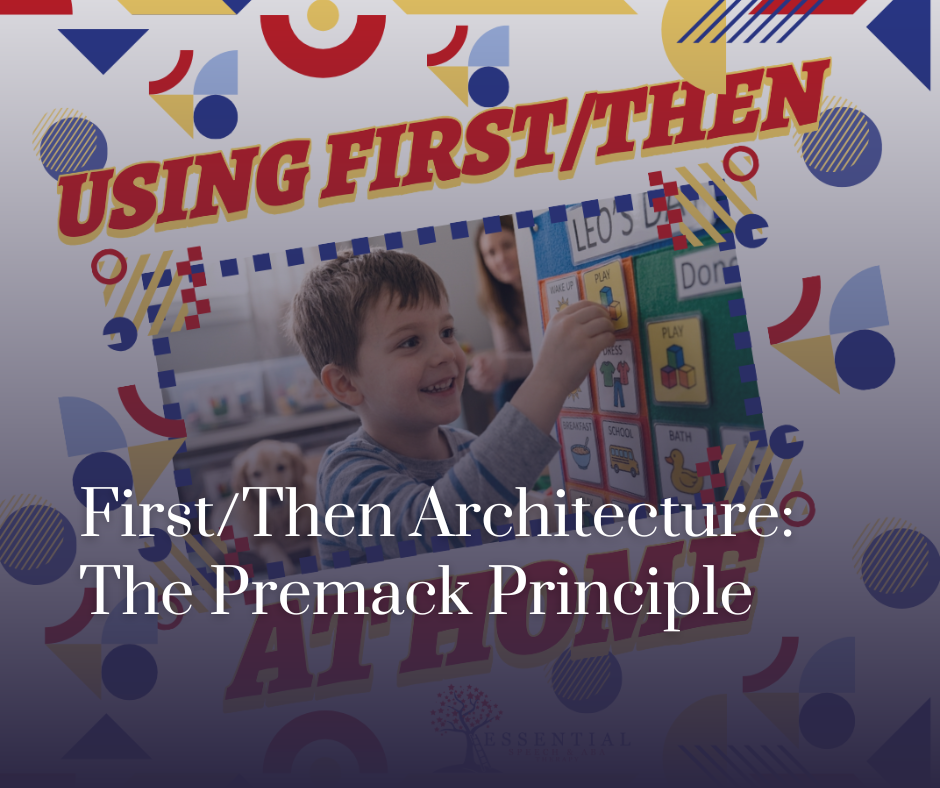
A First/Then board is a visual support—usually a simple card divided into two sections.
- “First”: This side features a picture or word representing the non-preferred task (e.g., putting on shoes, finishing a math worksheet, brushing teeth).
- “Then”: This side features a picture or word representing the preferred activity or reward (e.g., iPad time, a favorite snack, jumping on the trampoline).
By putting these two things side-by-side, you are providing a visual contract. It reduces the “language load” on the brain. When a child is frustrated, verbal instructions like “When you are done with your homework, we can go to the park” can be lost in the noise. A visual board stays constant and unmoving.
3. Why It Works: Reducing Conflict and Anxiety
Transition Management
Transitioning from a favorite activity to a chore is a major trigger for meltdowns. The Premack Principle makes the “end” of the chore visible. It reassures the individual that the things they love are not gone forever; they are just on the other side of a specific task.
Language Processing
Many autistic individuals process visual information faster than auditory information. When a caregiver says, “First wash your hands, then you can have a cookie,” the child might only hear “wash hands” (and resist) or “cookie” (and demand it immediately). The board allows them to see the sequence simultaneously.
Autonomy and Predictability
Predictability is the antidote to anxiety. When an individual knows exactly what is expected of them and exactly what they will get in return, the environment feels safer. It moves the dynamic from “I am forcing you to do this” to “Here is the path to get what you want.”
4. How to Implement It Effectively
Start Small
If you are just starting, don’t use “First/Then” for a two-hour cleaning session. Start with a “First” task that takes 30 seconds.
- First: Put one toy in the bin.
- Then: 5 minutes of a favorite video.
- This builds trust in the system. The individual learns that “Then” always happens.
Use High-Value Reinforcers
The “Then” must be actually motivating. If the reward is “playing outside” but the child is tired and wants to nap, the Premack Principle will fail. The reward must outweigh the “cost” of the effort required for the “First” task.
Be Immediate
Especially in the beginning, the “Then” should happen the split second the “First” is completed. Delayed gratification is a skill that must be built over time. In the early stages, the link between the work and the reward must be instantaneous.
Language Matters
Keep your verbal prompts minimal. Instead of a long explanation, simply point to the board and say, “First shoes, then park.” This prevents the “negotiation” phase where the individual tries to argue their way out of the task.
5. Common Pitfalls and How to Avoid Them
The “Bait and Switch”
The most common way to break the Premack Principle is to change the “Then” after the “First” is done. If the board said “First shower, then iPad,” and you realize the iPad isn’t charged so you say, “Actually, then we’ll read a book,” you have broken the contract. Trust is the currency of behavior management; once broken, the board becomes a source of stress rather than a tool for safety.
Using it as a Threat
There is a subtle but vital difference between a bribe, a threat, and a reinforcer.
- Threat: “If you don’t do your work, no iPad!” (Focuses on the negative).
- Premack: “First work, then iPad.” (Focuses on the path to the positive).
- The tone should be neutral and supportive, not adversarial.
Making the “First” Too Long
If the “First” task is too complex, the individual may lose sight of the “Then.” If you have a big task, break it down. Instead of “First clean your room,” try “First put clothes in the hamper, then [reward].” Then, create a new board: “First put toys on the shelf, then [reward].”
6. Beyond the Board: Natural Contingencies
As an individual grows, the Premack Principle can transition from a physical board to a verbal “contract” or even a self-management tool.
Adults may also use this for ourselves. You might decide, “First I will answer these five emails, then I will spend ten minutes on my special interest.” This is the ultimate goal: moving from external regulation to internal self-regulation.
7. The Connection to Safety
In the context of our previous discussion on airplanes, water, and festivals, the Premack Principle is a literal lifesaver.
- At a Festival: “First we walk to the First Aid station to get your ID bracelet, then we go to the funnel cake stand.”
- On a Plane: “First we keep the seatbelt on until the light goes off, then we open the snack box.”
- At the Pool: “First we put on the life jacket, then we get in the water.”
By anchoring high-risk safety behaviors (like wearing a life jacket or staying seated) to high-motivation rewards, you create a reliable behavioral loop that keeps the individual safe even in stressful environments.
Conclusion
The Premack Principle is more than just a trick to get chores done; it is a way of communicating respect and clarity. It acknowledges that some things are hard, but it promises that the hard things lead to good things. For the autism community, this clarity is the foundation of a calmer, safer, and more predictable life.
Pro Tip for Word: Use a 2-column table in Word to create your own “First/Then” visual. Label the left column “First” and the right “Then,” and you can paste images directly into the cells!