As a parent of a child in ABA therapy, you may notice your child performing skills at the clinic that they don’t use at home or in public. It can be incredibly frustrating. Why will they perform for a therapist, but not for you?
Your child is likely struggling with generalization—the ability to perform a skill across multiple settings, with different people, and using varied materials.
Generalization rarely happens naturally. It requires intentional practice with different social partners. For example, your child might greet peers at the center but need heavy prompting to greet someone at church. To bridge this gap, collaborate with your child’s Board Certified Behavior Analyst (BCBA) to understand their current goals and establish realistic expectations for home and community life.
What is “Generalization” and Why Does It Matter?
Generalization isn’t just ABA jargon; it is the ultimate goal of therapy. It transforms a skill from a rigid, clinic-only routine into a functional tool for real life.
We break generalization down into three core dimensions:
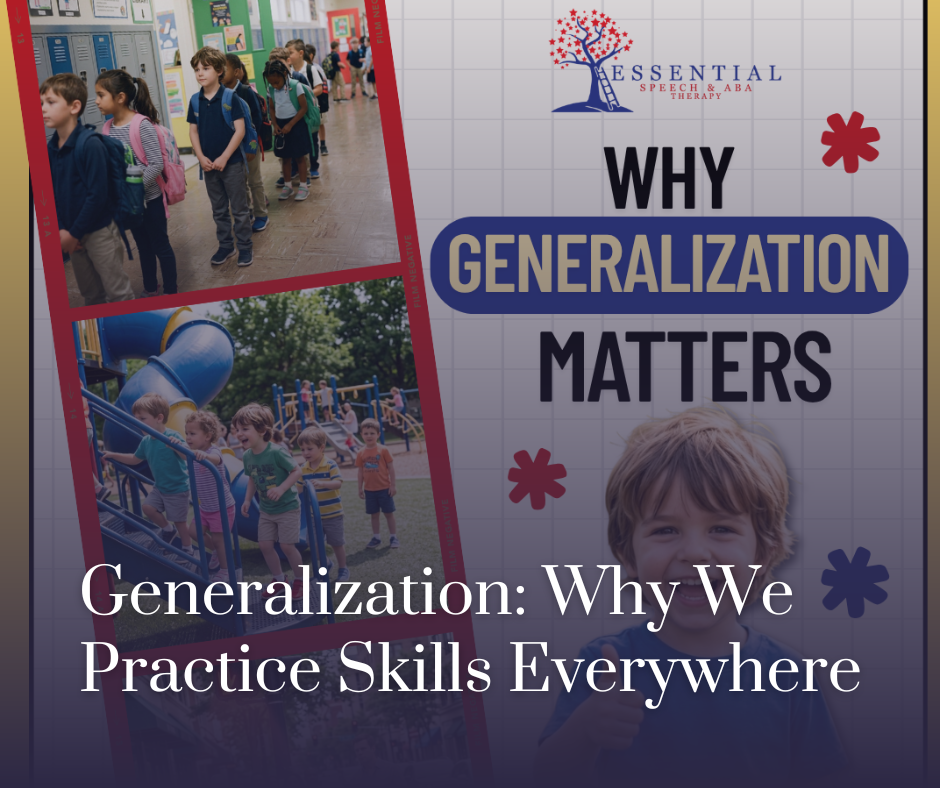
- Setting Generalization: Moving a skill from the clinic to the living room, school, or park.
- People Generalization: Expanding a skill from a trained therapist to parents, siblings, and teachers. If a child only responds to their Registered Behavior Technician (RBT), the skill isn’t fully functional yet.
- Response Generalization: Applying a core skill using varied behaviors. Instead of only saying a scripted “Hi,” your child learns to wave, say “Hello,” or give a high-five.
The true goal of ABA is not to create a child who performs perfectly in a clinical bubble, but to increase independence and improve your family’s overall quality of life.
Phase 1: Bringing Skills Home
The process of real-world mastery begins by bridging the gap between the clinic and your front door.
Consistency is Key
To prevent confusion, sync up with your therapy team. Use the exact same verbal prompts, visual cues, and language at home that the therapists use at the center. Matching these expectations builds your child’s confidence.
Environmental Tweaks
Home is naturally more chaotic than a quiet therapy room. Initially, try to recreate some clinic success criteria: clear off a specific table for tasks or turn off the TV to minimize distractions. As your child succeeds, gradually fade these modifications to return the environment to its natural state.
Daily Routine Integration
You do not need to run formal “therapy sessions” at home. Instead, weave practice into your existing routines:
- Mealtime: Practice requesting (manding) a drink or waiting patiently for a snack.
- Bedtime: Use a visual schedule to guide your child through brushing teeth and putting on pajamas independently.
- Chores: Break down tasks—like putting toys in a bin—into simple, sequential steps.
A Note for Caregivers: You are the co-captain of this ship, not a replacement therapist. Your role is simply to provide the consistency and real-world space for these skills to take root.
Phase 2: Moving into the Community
Once a skill is stable at home, you can begin introducing public environments.
The Pre-Game Plan
Before leaving the house, take a few minutes to set up your outing for success:
- Use Social Narratives: Read a brief social story together so your child knows what to expect (e.g., “First we walk into the store, then we buy cereal, then we leave”).
- Set Clear Expectations: State the desired behavior simply before unbuckling their seatbelt.
- Pack a “Success Kit”: Bring preferred reinforcers, headphones, or sensory tools to help them regulate if they become overwhelmed.
Scaffolding the Environment
Start small and build up. Do not make your first outing a crowded grocery trip during Friday rush hour. Instead, try a quick, five-minute trip on a quiet Tuesday morning to buy a single item. Celebrate the quick win and gradually increase the difficulty of future trips.
Navigating Public Meltdowns
Public meltdowns are stressful, but they happen. When they do, take a deep breath and ignore any judgment from onlookers. Your priority is your child’s safety and learning, not public perception. Stick to the plan developed with your BCBA and stay calm.
Key Strategies for Success
Keep these four practical strategies in your toolkit:
- Fade Prompts Quickly: Avoid prompt dependency by transitioning from direct guidance to natural environmental cues (e.g., pointing toward the door instead of saying “get your shoes”).
- Vary Reinforcement: Move away from artificial rewards (like continuous edibles or tokens) toward natural reinforcers, such as getting a toy after paying the cashier or sliding after waiting in line.
- Involve Peers and Siblings: Children learn rapidly from watching each other. Lean on siblings or peers to provide natural social modeling.
- Celebrate Small Wins: Progress is rarely linear. Celebrate the small victories—like holding your hand in the parking lot for ten seconds or pointing to a picture instead of crying.
You’ve Got This
Generalization is the true measure of behavior analysis. It is the exact moment therapy stops feeling like work and begins looking like everyday life. To every parent putting in the hours, navigating public spaces, and patiently reinforcing progress: you are doing the hard, meaningful work that changes futures. Trust the process, be gentle with yourself, and lean on your clinical team.
What do you think? What is one skill your child mastered at the center that you are currently trying to bring home?