When your child is not speaking as expected, it is natural to worry. You may find yourself waiting hopefully for a first word, comparing milestones, or wondering whether your child will ever be able to tell you what they want, how they feel, or what happened during their day.
Those feelings are understandable. Most parents imagine hearing their child say “mama,” “dada,” “I love you,” or any of the countless words that help us feel connected to one another. Wanting your child to develop spoken language does not mean you are overlooking their strengths. It means you want to know them, understand them, and help them move through the world with greater confidence.
But speech and communication are not exactly the same thing.
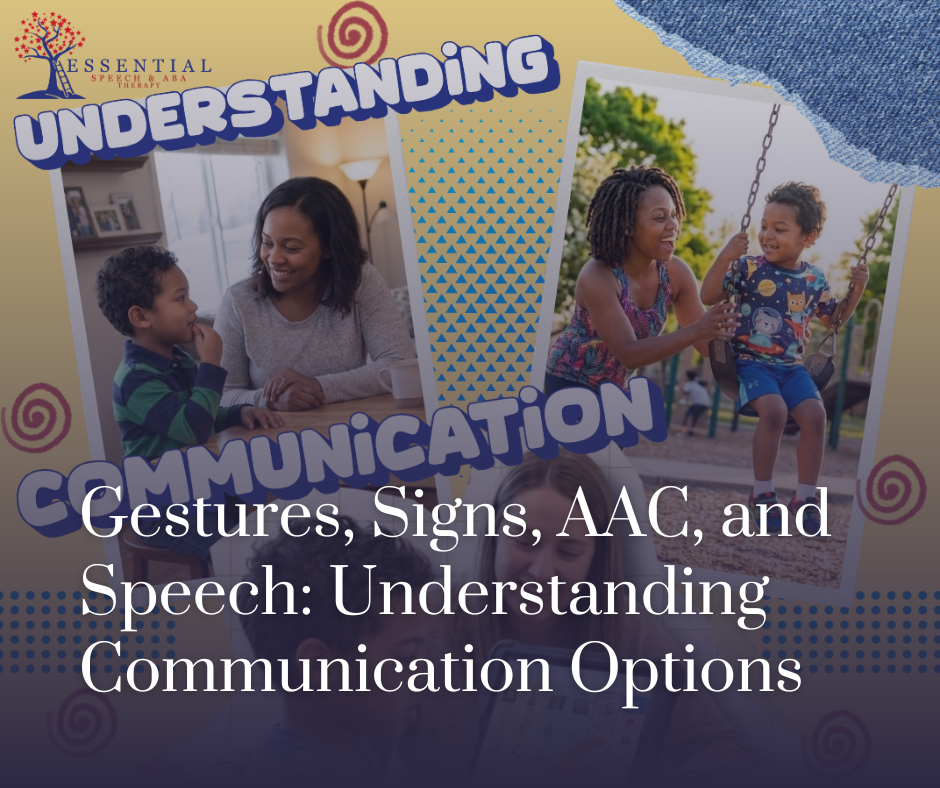
Speech is the physical production of sounds and words. Communication is the broader ability to share a need, thought, feeling, preference, question, or experience with another person. A child may communicate by looking toward an object, pointing, reaching, signing, exchanging a picture, selecting a symbol on an AAC device, speaking, or combining several of these methods.
Every one of those attempts can carry meaning.
At Essential Speech and ABA Therapy, we believe children should not have to wait for spoken words before they have an effective way to communicate. Spoken language may remain an important goal, but communication can begin right now. By recognizing and supporting different forms of communication, we can reduce frustration, strengthen relationships, and help children experience the power of being understood.
Why Communication Support Matters
Imagine knowing exactly what you want but being unable to express it in a way that others understand.
You are thirsty, but no one knows. A room is too loud, but you cannot ask to leave. You want your favorite toy, need help opening something, or simply want someone to notice what you are showing them. When your attempts are missed repeatedly, frustration is an understandable response.
For some children with speech or language delays, crying, dropping to the floor, pushing something away, withdrawing, or engaging in other challenging behavior may be one of the clearest ways they currently know to communicate.
This does not mean every behavior has the same cause, and it does not mean communication support will resolve every challenge. It does mean we should remain curious about what a child may be trying to tell us.
When we give children clearer, more accessible ways to communicate, we give them alternatives. They can begin to request, protest, ask for help, make choices, share enjoyment, and participate more fully in everyday life.
The goal is not to make every child communicate in exactly the same way. The goal is to help each child develop a reliable system that works for them.
Gestures and Body Language: Communication Is Already Happening
Before children begin speaking, they typically communicate through movement, facial expressions, sounds, and gestures. They may reach to be held, turn away from something they do not want, point toward an interesting object, or bring an item to an adult for help.
Children with language delays may also use these forms of communication, although their gestures may be subtle, inconsistent, or easy to miss.
Common examples include:
- Looking toward a desired object
- Reaching or pointing
- Bringing an adult to something they want
- Giving an item to request help
- Shaking their head or turning away
- Raising their arms to be picked up
- Showing an object to share interest
- Using facial expressions or body movements to indicate discomfort or excitement
These actions may appear simple, but they represent important communication skills. A child who gives you a closed container may be saying, “Help me open this.” A child who pushes an item away may be saying, “No,” “I’m finished,” or “I don’t want that.”
When adults notice and respond to these attempts, children begin learning an essential lesson: communication works.
Parents and clinicians can build on gestures by pairing them with simple spoken language, signs, pictures, or AAC. For example, if a child reaches for bubbles, an adult might say “bubbles,” model the sign for “more,” or point to “bubbles” on the child’s communication system before honoring the request.
The child does not need to imitate every model. The adult is simply showing them additional ways their message can be expressed.
Sign Language: A Visual Way to Express Meaning
Some children benefit from using manual signs, including signs from American Sign Language or simplified signs chosen for everyday routines.
Signs can give children a way to express common messages without requiring the precise coordination involved in spoken language. Early signs may include words such as “more,” “help,” “open,” “stop,” “eat,” “drink,” or “all done.”
One advantage of signing is that it does not require a separate device or set of materials. A child’s hands are always available. Signs can also be modeled naturally during play, meals, transitions, and other daily activities.
However, sign language is not the best or only choice for every child.
Some children have fine-motor, imitation, or motor-planning differences that make certain signs difficult to produce. A child may also create an approximation of a sign rather than forming it exactly. Communication partners should learn to recognize and honor consistent approximations when the meaning is clear.
Another consideration is that not everyone in the child’s community will understand sign language. A parent, sibling, teacher, or therapist may recognize a child’s signs, while an unfamiliar person may not. For that reason, signs are often used as part of a broader communication system rather than as the child’s only option.
A speech-language pathologist can help determine whether signing is appropriate and which signs are functional, accessible, and meaningful for the child.
What Is AAC?
Augmentative and Alternative Communication, commonly called AAC, includes methods of communication used in addition to or instead of spoken language.
The word “augmentative” means the system adds to speech. The word “alternative” means it can provide another option when speech is not currently available or reliable.
AAC is not limited to electronic devices. It includes a wide range of communication methods.
Unaided AAC
Unaided AAC does not require an external tool. Examples include:
- Gestures
- Facial expressions
- Body language
- Manual signs
Aided AAC
Aided AAC involves an external communication tool. It may be low-tech or high-tech.
Low-tech AAC can include:
- Printed communication boards
- Picture cards
- Choice boards
- Flip books
- Letter boards
- Written words
- The Picture Exchange Communication System, or PECS
High-tech AAC can include:
- Speech-generating devices
- Dedicated communication tablets
- Communication applications installed on a tablet
- Systems that allow a child to select pictures, words, or letters to produce spoken messages
Some children use a small number of pictures to make basic requests. Others use robust AAC systems containing extensive vocabulary that allows them to ask questions, comment, describe experiences, express emotions, tell stories, and advocate for themselves.
AAC should not be viewed as a last resort or something a child must “earn.” If a child has difficulty communicating effectively, an AAC evaluation may help identify tools that can support them now.
Will AAC Stop My Child From Talking?
This is one of the most common concerns families have, and it is an important question.
Parents sometimes worry that if communication becomes easier through pictures or a device, their child will lose motivation to speak. However, available research does not indicate that AAC prevents spoken-language development. For many children, AAC can support communication development while speech continues to be addressed.
AAC gives a child access to words and language without requiring them to produce those words verbally first. When adults model language using the child’s system while speaking naturally, the child can see and hear how words are used in meaningful situations.
Most importantly, AAC reduces the pressure of having no dependable way to communicate.
A child does not need to choose permanently between speech and AAC. They may use an AAC device in one situation, a gesture in another, and spoken words when those words are available. Communication can be flexible.
If spoken language develops, AAC does not have to disappear immediately. It can remain available when a child is tired, overwhelmed, ill, misunderstood, or unable to access speech consistently.
Spoken Language Can Still Be an Important Goal
Supporting alternative forms of communication does not mean giving up on speech.
Speech-language pathologists can help children develop the skills involved in understanding and using language, producing speech sounds, coordinating oral movements, and communicating more clearly. The specific focus will depend on the child’s individual strengths and needs.
For some children, spoken language becomes their primary form of communication. Other children may use speech together with signs, gestures, or AAC. Some may rely primarily on AAC throughout their lives.
There is no single path that determines whether communication is successful.
The most important question is not simply, “Is the child talking?” It is also:
- Can the child express wants and needs?
- Can they say no or ask to stop?
- Can they request help?
- Can they make meaningful choices?
- Can they share an idea or experience?
- Can they communicate discomfort or pain?
- Can they connect with the people around them?
- Do the important people in their life understand and respond to their communication?
Speech is valuable, but a child’s independence, safety, and connection should not depend entirely on whether spoken words are currently available.
How Speech, Occupational Therapy, and ABA Can Work Together
Communication is part of nearly every moment of a child’s day. That is why collaboration among families and clinicians is so important.
The Speech-Language Pathologist
A speech-language pathologist evaluates how a child understands and expresses language. The SLP may assess spoken communication, gestures, social communication, play skills, motor-speech abilities, and potential AAC options.
When AAC is appropriate, the SLP may help identify a system, organize vocabulary, teach communication partners how to model it, and expand the child’s communication beyond requesting.
The Occupational Therapist
An occupational therapist can help determine whether motor, sensory, visual, or positioning needs affect the child’s ability to access a communication system.
For example, the OT may help with seating and positioning, screen access, hand use, visual attention, or adaptations that make the system easier and more comfortable to use. If a child struggles to isolate one finger, tolerate a device, or visually scan multiple symbols, collaboration between the OT and SLP can be especially helpful.
The ABA Team
The ABA team can help make communication useful across real-life routines. Rather than limiting practice to a therapy table, the team can create opportunities for the child to communicate during play, transitions, meals, social interactions, self-care, and community activities.
The ABA team can also collect information about when and how a child communicates, identify situations that lead to frustration, and help caregivers and other team members respond consistently.
The purpose is not to demand a particular form of communication before meeting a child’s needs. It is to help the child learn that safe, accessible communication is understood across people and environments.
Parents and Caregivers
Families are essential members of the team. Parents know their child’s routines, preferences, personality, and subtle communication signals in a way no evaluation can fully capture.
A communication system is most useful when families understand why it was selected, feel comfortable using it, and can share honest feedback about what is or is not working at home.
Collaboration means listening to the family, respecting the child’s responses, sharing information across disciplines, and adjusting the plan when needed.
What Is Total Communication?
Many children benefit from a total communication approach. This means recognizing and encouraging multiple ways of communicating instead of requiring the child to use only one method.
A child might:
- Point to the refrigerator to show they are hungry
- Sign “more” during a favorite activity
- Use an AAC device to ask for a specific snack
- Say “no” when they want an activity to stop
- Hand an adult a toy that needs help
- Use facial expressions and body language to show excitement
- Combine a spoken word with a gesture or symbol
All of these can be meaningful communication.
Total communication gives children flexibility. Speech may not be equally available in every setting or emotional state. A child who speaks comfortably at home may struggle in a noisy classroom. A child who uses several spoken words may need AAC to express something more complex. A child may also communicate differently when tired, anxious, excited, or overwhelmed.
Having more than one tool does not make communication less meaningful. It makes the child’s communication system more dependable.
How Parents Can Support Communication at Home
You do not need to turn every family interaction into a therapy session. Some of the most valuable support happens during ordinary moments.
Start by noticing what your child is already doing. Watch where they look, what they reach for, what they bring to you, and how they show that they want more or need a break.
You can also:
- Respond to meaningful gestures and communication attempts
- Use short, clear language during familiar routines
- Offer manageable choices
- Pause long enough to give your child an opportunity to respond
- Model signs, pictures, or AAC without requiring immediate imitation
- Keep the child’s communication system available
- Avoid removing AAC as a punishment
- Share new words, signs, or communication patterns with the clinical team
- Celebrate the message, not just the method used to express it
If your child selects the wrong symbol accidentally, approximates a sign, or produces an unclear word, focus first on understanding the likely message. Communication should feel safe enough for children to keep trying.
When Should a Family Ask for Help?
Consider speaking with your child’s pediatrician or requesting a speech-language evaluation if your child:
- Is not meeting expected communication milestones
- Has difficulty expressing basic wants and needs
- Becomes frequently frustrated when trying to communicate
- Has lost previously used words or communication skills
- Uses language inconsistently
- Has speech that is difficult for familiar or unfamiliar listeners to understand
- Relies heavily on others to anticipate their needs
- Has difficulty understanding language or following everyday directions
- Has a communication system that is not meeting their current needs
You do not need to wait until a child has no speech at all before asking about AAC. Children with some spoken language may also benefit from additional communication support.
An evaluation is not about forcing a child into one method. It is an opportunity to understand how the child currently communicates and identify options that may give them greater access, confidence, and independence.
Every Child Deserves to Be Heard
At Essential Speech and ABA Therapy, we believe communication is a basic human need. Every child deserves a dependable way to express preferences, ask for help, share joy, set boundaries, and connect with the people who matter to them.
For one child, that may be spoken language. For another, it may be signs or a speech-generating device. For many children, it will be a combination of gestures, pictures, AAC, and speech that changes over time.
Our responsibility is not to decide that one form of communication is more worthy than another. It is to meet the child where they are, recognize the meaning in what they are already telling us, and help them build new skills without taking away the tools that currently give them a voice.
When families, speech-language pathologists, occupational therapists, behavior analysts, and other caregivers work together with empathy and respect, communication becomes more than a therapy goal. It becomes a pathway to stronger relationships, greater independence, meaningful participation, and a fuller sense of belonging.
A child’s voice is not limited to the words they can say aloud.
Their voice is present every time they reach, point, sign, select a symbol, make a sound, speak a word, or find a new way to say, “This is what I need. This is what I feel. This is who I am.”
And every form of that voice deserves to be heard.