When your child has a speech or language delay, learning how to help them can feel overwhelming. You might hear lots of complicated therapy terms, but what you really need are simple, proven ways to encourage your child to communicate in everyday life.
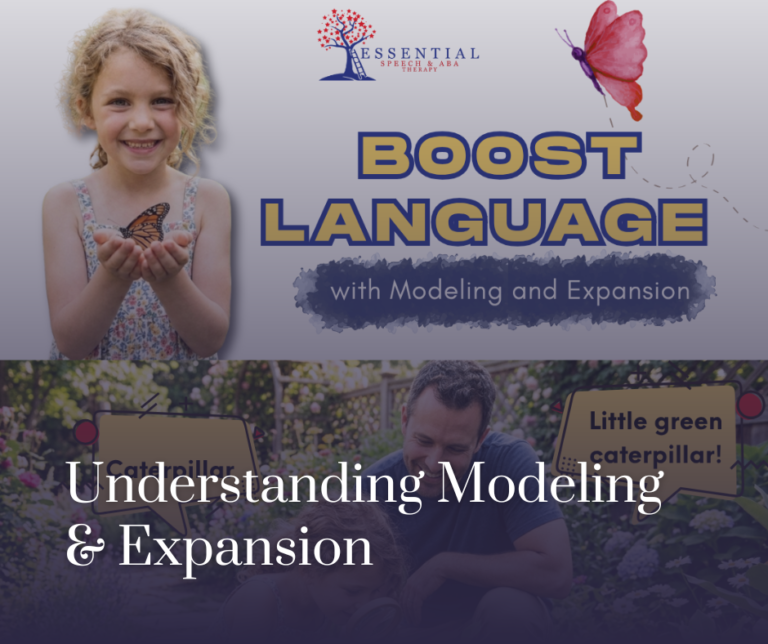
Two of the most powerful strategies you can use at home are Modeling and Expansion.
These are not rigid drills or lessons that require flashcards. Instead, they are easy, conversational tools you can use during daily routines, like bath time, dinner, or playing on the living room floor.
Here is how modeling and expansion work, why they help your child’s brain learn language, and how you can start using them today.
Strategy 1: Modeling (Showing the Way)
What is Modeling?
Modeling simply means saying the exact word or phrase your child would say if they could, right in the moment they need it. You are providing a clear, correct example of language without asking your child to repeat it back to you.
When a child struggles to talk, parents naturally want to prompt them: “Say ‘apple’! Can you say ‘apple’?”
While this comes from a place of love, putting kids on the spot can cause frustration and stress. Modeling removes that pressure entirely. Instead of asking your child to perform, you simply narrate what is happening around them.
The “One-Word-Up” Rule
To model effectively, match your child’s current communication level and add just one or two words. If you use sentences that are too long or complex, it is harder for their brain to process the words.
- If your child uses gestures or sounds: Model single, clear words.
- Your child reaches for milk: You say, “Milk.”
- Your child pushes a toy car: You say, “Go!” or “Vroom!”
- If your child uses single words: Model two-word phrases.
- Your child points to a dog: You say, “Big dog!” or “Dog walking!”
- Narrate what is happening:
- Talk about what you are doing: “Mommy is opening the box. Open! Open box!”
- Talk about what your child is doing: “You are jumping! Jump, jump, jump!”
Strategy 2: Expansion (Building on Their Words)
What is Expansion?
If modeling is providing the first word, expansion is taking what your child already says and gently stretching it.
When your child speaks, you repeat their thoughts back to them while adding a few meaningful words or details. You aren’t correcting them or telling them they were wrong; instead, you are simply validating what they said and modeling a slightly expanded version of what they communicated.
Because you respond immediately to something they are interested in, they are getting meaningful exposure to new words and phrases.
What Expansion Looks Like in Real Life
Expansion takes your child’s words and adds context, grammar, and detail without interrupting play.
| What Your Child Says | How You Expand | What You Are Teaching |
| “Juice!” | “More juice!” or “Drink juice!” | Combining two words together |
| “Doggy run!” | “The doggy is running!” | Full sentence structure (is, -ing) |
| “Big truck.” | “Yes, that is a huge yellow truck!” | Describing colors and size |
| “Ball fall.” | “Uh oh, the red ball fell down!” | Explaining actions and direction |
Using Modeling & Expansion with AAC Devices and Signs
Modeling and expansion are not just for spoken words. If your child uses a communication device (AAC), picture cards, or sign language, these strategies are just as important.
To learn how to use a device or sign, children need to see the people around them using it, too.
- Modeling on a Device: If your child reaches for bubbles, tap the “Bubbles” icon on their tablet while saying aloud, “Bubbles!”
- Expanding on a Device: If your child taps the “Eat” button, validate it, tap “Eat”, and then tap “Apple”, saying aloud, “Eat apple! Let’s eat an apple.”
Whether your child talks, points, signs, or uses a screen, these tools help them build bigger ideas over time.
4 Easy Tips for Home Practice
- Pause and Wait (The 5-Second Rule): Children with language delays need extra time to process what they hear. After you model or expand a phrase, pause for 5 to 10 seconds before speaking again. Give them time to think without rushing in.
- Focus on Connection, Not Correction: Avoid requiring your child to repeat the word or phrase every time you model it. Give them opportunities to hear the language without placing pressure on them to immediately imitate it.
- Keep it Fun and Playful: Language flows best during low-stress play. Follow your child’s interests. If they love lining up toy trains, sit nearby and talk about trains rather than trying to switch to a book.
- Celebrate Every Effort: Value all communication, whether it’s a look, a point, a sound, a sign, or a tap on a screen. When children see that their attempts to communicate bring positive attention, they want to interact even more.
Small Steps Lead to Big Progress
You don’t need to sit your child down for formal “speech homework.” Language development happens across thousands of tiny everyday moments.
By taking the pressure off, modeling the next simple word, and gently expanding their thoughts, you give your child the tools they need to express themselves with confidence.