For many parents, the idea of speech therapy comes with a lot of uncertainty.
Will my child sit at a table the whole time?
Will they be expected to repeat words over and over?
What actually happens in a session?
The reality is often very different from what people imagine.
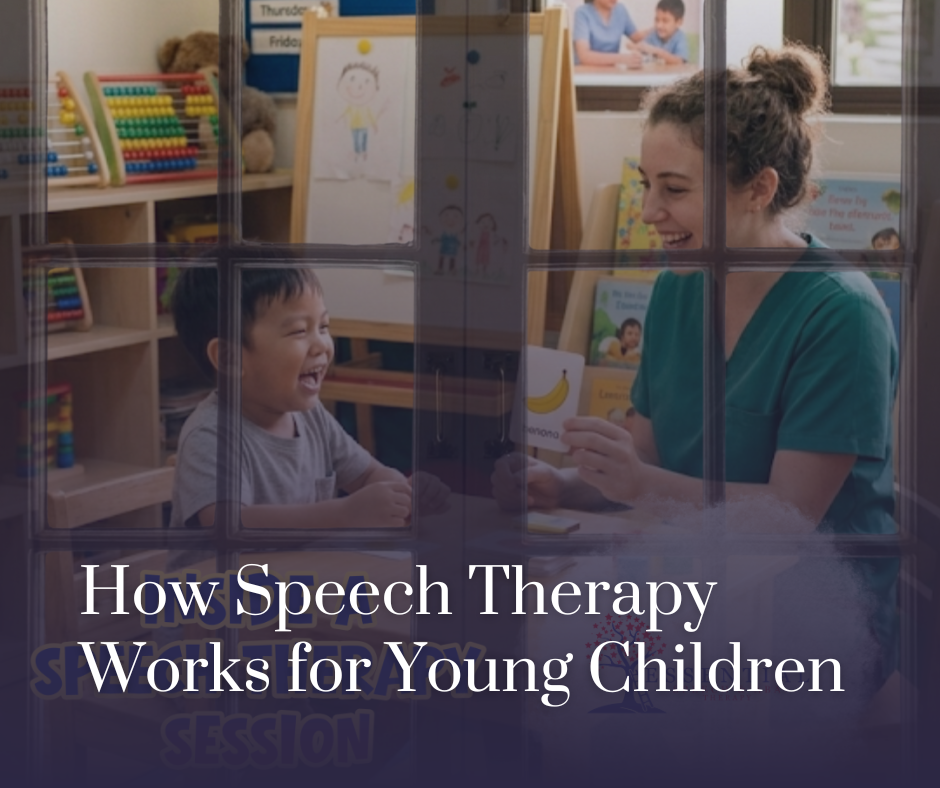
Speech therapy for young children is play-based, interactive, and highly individualized. It is designed to meet children where they are developmentally while helping them build the skills they need to communicate more effectively.
Grounded in research and best practices from the American Speech-Language-Hearing Association, this article walks you through what speech therapy actually looks like for young children and what makes it effective.
First, What Is Speech Therapy?
Speech therapy is provided by a licensed speech-language pathologist (SLP) who evaluates and treats communication challenges, including:
- Delayed speech or language
- Difficulty understanding language
- Trouble forming sounds clearly
- Social communication challenges
- Feeding and oral-motor concerns
For young children, therapy is not about “fixing” them. It is about building skills in a way that feels natural, engaging, and achievable.
What Makes Pediatric Speech Therapy Different?
Speech therapy for adults and older children can look very structured.
For toddlers and preschoolers, it looks very different.
It Is Play-Based
Young children learn through play, not drills. Therapy sessions are built around activities like:
- Playing with toys
- Reading books
- Singing songs
- Pretend play
To an outside observer, it may just look like play. But every activity is intentional and targeted.
It Is Child-Led
Therapists often follow the child’s interests rather than forcing a specific activity.
If a child is interested in bubbles, the therapist may spend much of the session using bubbles to work on:
- Requesting (“more”)
- Eye contact
- Turn-taking
- Sound imitation
This approach increases engagement and learning.
It Is Structured Without Feeling Rigid
Even though sessions feel natural, they are carefully planned.
SLPs are constantly:
- Tracking progress
- Adjusting prompts
- Increasing or decreasing support
- Targeting specific goals
What Happens During a Typical Session?
While every session is individualized, most follow a similar flow.
1. Warm-Up and Connection
The therapist begins by engaging the child in something motivating.
This might look like:
- Greeting routines
- A favorite toy
- A familiar activity
The goal is to build comfort and engagement.
2. Targeted Play Activities
The majority of the session happens here.
The therapist uses play to target specific communication goals, such as:
- Encouraging first words
- Expanding phrases
- Improving understanding of directions
- Practicing speech sounds
- Building social interaction
For example:
- Using a toy farm to work on animal sounds and labeling
- Playing with a puzzle to practice requesting help
- Blowing bubbles to encourage eye contact and turn-taking
3. Modeling and Prompting
A key part of therapy is how the therapist supports the child.
Instead of demanding responses, SLPs:
- Model words and phrases
- Use gestures or visuals
- Provide gentle prompts
- Reinforce attempts
This creates a low-pressure environment where children are more likely to try.
4. Parent Involvement (When Appropriate)
Many sessions include parent coaching.
This might involve:
- Demonstrating strategies
- Explaining what is being targeted
- Giving simple ways to practice at home
Research shows that parent involvement significantly improves outcomes, especially in early intervention (ASHA, n.d.).
5. Wrap-Up and Transition
Sessions typically end with:
- A preferred activity
- A quick review
- Transition support
This helps the child leave on a positive note and maintains engagement for future sessions.
What Skills Are Being Targeted?
Even though sessions look like play, they are addressing very specific skills.
Early Communication Skills
- Eye contact
- Joint attention
- Gestures (pointing, reaching)
Language Development
- Vocabulary
- Combining words
- Understanding directions
Speech Sound Development
- Producing sounds clearly
- Improving intelligibility
Social Communication
- Turn-taking
- Initiating interaction
- Responding to others
Functional Communication
- Requesting
- Protesting
- Commenting
These skills are essential for daily life, not just speech.
How Progress Is Measured
Progress in speech therapy is not always immediate or linear.
SLPs track progress through:
- Data collection during sessions
- Observations across activities
- Parent feedback
- Changes in functional communication
Sometimes progress looks like:
- A child pointing instead of crying
- Attempting a sound for the first time
- Following a direction independently
These small steps are meaningful and build over time.
What If My Child Doesn’t Sit Still?
This is one of the most common concerns.
Young children are not expected to sit at a table for long periods.
Therapists are trained to:
- Follow the child’s movement
- Incorporate activity and play
- Adjust expectations based on attention span
Movement is not a barrier. It is often part of the therapy.
How Long Does It Take to See Progress?
This depends on several factors:
- The child’s starting point
- Frequency of therapy
- Consistency at home
- Underlying needs
Some children make rapid progress. Others require more time and support.
What matters most is:
- Consistency
- Early intervention
- Collaboration between therapist and family
The Role of Collaboration
Speech therapy does not happen in isolation.
For many children, especially those with developmental differences, progress is strongest when care is collaborative.
This may include:
- Speech-language pathologists
- Behavior analysts
- Occupational therapists
- Parents and caregivers
When everyone is aligned, children receive consistent support across environments.
What Parents Should Take Away
Speech therapy for young children is not about pressure or perfection.
It is about:
- Meeting your child where they are
- Creating meaningful opportunities to communicate
- Building skills through connection and play
If you walk into a session and it looks like “just play,” that is often a good sign.
Because for young children, play is how learning happens.
Final Thoughts
Understanding what speech therapy actually looks like can remove a lot of uncertainty and hesitation.
It is not rigid.
It is not intimidating.
It is not one-size-fits-all.
It is thoughtful, intentional, and built around how children naturally learn.
And when done well, it creates opportunities for children to communicate, connect, and grow in ways that carry far beyond the therapy room.