When parents hear the term “Applied Behavior Analysis” or “ABA”, they often think about teaching new skills or reducing challenging behaviors. What many people don’t realize is that one of the most powerful tools used in ABA is also one of the simplest: understanding what happens before and after a behavior occurs.
Behavior does not happen in isolation. Every behavior occurs within a context. To truly understand why a behavior is happening (and how to encourage meaningful change), we need to look beyond the behavior itself.
This is where the ABC model comes in.
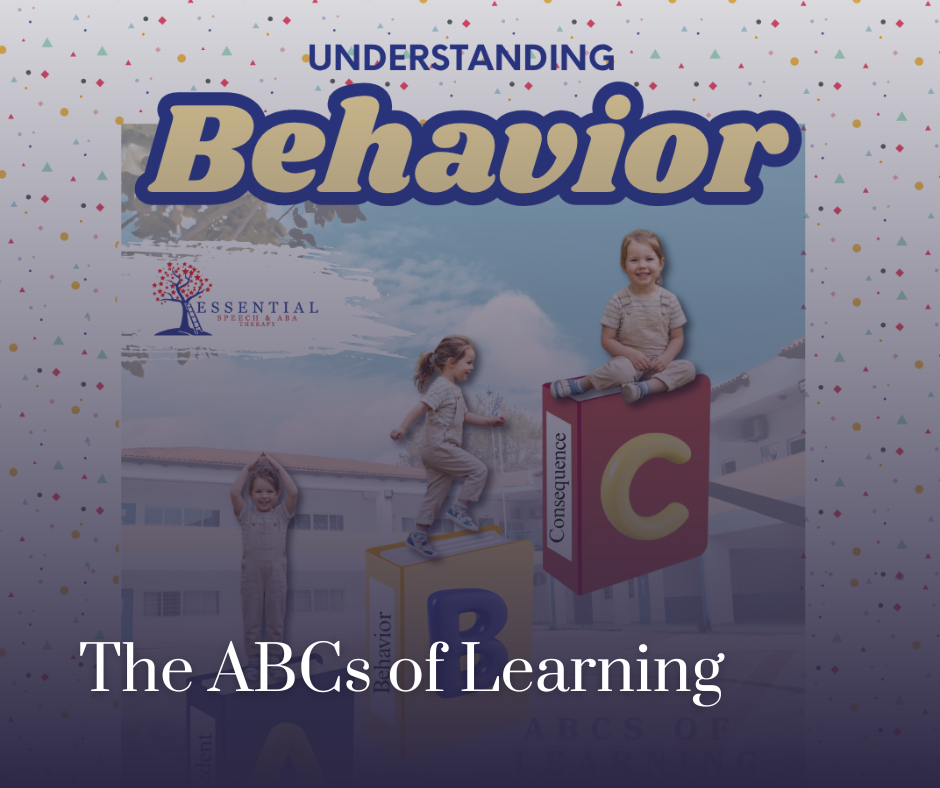
The ABCs of behavior stand for:
- A – Antecedent: What happened immediately before the behavior?
- B – Behavior: What did the person do?
- C – Consequence: What happened immediately after the behavior?
Think of behavior as the middle of a sandwich. Most people focus only on the behavior itself, but the factors that occur before and after often provide the most valuable information. In many cases, the key to behavior change lies in adjusting antecedents and consequences rather than simply reacting to the behavior.
Understanding the ABCs can help parents, caregivers, teachers, and therapists better support learning and development in everyday situations.
What Is an Antecedent?
An antecedent is anything that occurs immediately before a behavior.
Antecedents can include:
- Instructions or requests
- Environmental changes
- Social interactions
- Transitions between activities
- Access to preferred items
- Sensory experiences
- Changes in routine
In other words, antecedents set the stage for behavior.
Imagine a child is playing with a favorite toy and a parent says, “It’s time to clean up.”
The instruction to clean up is the antecedent.
If the child begins crying, refuses to put away the toy, or throws the toy, those actions would be considered the behavior.
Understanding antecedents helps us identify potential triggers and opportunities for support.
Why Antecedents Matter
Many challenging behaviors occur because the environment is making success difficult.
For example, a child may struggle when:
- Transitions occur unexpectedly
- Directions are unclear
- Tasks are too difficult
- Sensory demands become overwhelming
- Preferred activities end abruptly
When we identify these patterns, we can often make small adjustments that reduce frustration and increase success.
Examples of antecedent strategies include:
- Providing visual schedules
- Giving countdown warnings before transitions
- Breaking large tasks into smaller steps
- Offering choices when appropriate
- Creating predictable routines
- Adjusting environmental distractions
Rather than waiting for a challenging behavior to occur, antecedent strategies aim to prevent problems before they begin.
What Is a Behavior?
The behavior is the action that occurs.
In ABA, behavior is defined as anything observable and measurable.
Examples might include:
- Asking for help
- Following directions
- Completing a task
- Crying
- Running away
- Hitting
- Raising a hand
- Sharing a toy
One important principle in behavior analysis is describing behaviors objectively.
Instead of saying:
“She was being difficult.”
We might say:
“She crossed her arms, turned away, and did not respond to instructions.”
Objective descriptions allow caregivers and professionals to better understand what is actually happening and identify effective solutions.
Every Behavior Serves a Purpose
One of the most important concepts in ABA is that behavior is communication.
Even when someone is unable to explain their thoughts verbally, their behavior often communicates a need, preference, feeling, or goal.
A child may engage in behavior to:
- Gain attention
- Access a preferred item or activity
- Avoid or escape something difficult
- Meet a sensory need
Understanding the purpose, or function, of behavior helps guide effective intervention.
Without understanding why a behavior occurs, it becomes much harder to teach meaningful alternatives.
What Is a Consequence?
A consequence is what happens immediately after a behavior occurs.
When people hear the word consequence, they often think of punishment. In behavior analysis, however, a consequence is simply the outcome that follows a behavior.
Consequences can include:
- Receiving praise
- Getting attention
- Accessing a preferred item
- Completing a task
- Losing access to an activity
- Escaping a demand
- Receiving assistance
Consequences matter because they influence whether a behavior is more or less likely to occur again in the future.
How Consequences Shape Learning
Imagine a child asks appropriately for a snack.
The parent responds by providing the snack.
The consequence (receiving the snack) increases the likelihood that the child will ask appropriately again in the future.
Now imagine a child screams whenever a difficult task is presented.
If the task is immediately removed every time screaming occurs, the child may learn that screaming is an effective way to avoid difficult work.
This doesn’t mean caregivers are intentionally reinforcing challenging behavior. Often, these patterns develop naturally and unintentionally.
The goal is not to assign blame. Instead, it is to understand how learning occurs so we can create more effective responses.
Looking Beyond the Behavior
One of the most common mistakes people make is focusing exclusively on the behavior they want to change.
For example:
- “How do we stop tantrums?”
- “How do we stop hitting?”
- “How do we stop refusing tasks?”
These are understandable questions, but they only focus on the middle of the ABC sequence.
To create lasting change, we need to ask additional questions:
- What happened before the behavior?
- What happened after the behavior?
- Is there a pattern?
- What might the child be communicating?
- How can we teach a more effective alternative?
When we analyze the entire ABC sequence, we often uncover valuable information that isn’t obvious at first glance.
A Real-Life Example
Let’s look at a common situation.
Antecedent
A parent tells their child it is time to stop playing a video game and begin homework.
Behavior
The child yells, throws the game controller, and refuses to move.
Consequence
The parent spends several minutes negotiating while homework is delayed.
At first glance, the focus may be on the yelling and refusal.
However, examining the ABCs reveals additional information.
Possible contributing factors might include:
- The transition was unexpected.
- The child was highly engaged in the activity.
- Homework feels difficult or overwhelming.
- Delaying homework was unintentionally reinforced.
Potential solutions could include:
- Giving a five-minute warning before transitions.
- Using a visual schedule.
- Breaking homework into smaller sections.
- Reinforcing successful transitions.
- Teaching coping strategies for frustration.
By addressing antecedents and consequences, we often create more effective and sustainable behavior change.
Using ABCs to Support Learning
The ABC framework is not only useful for reducing challenging behaviors—it is also a powerful tool for teaching new skills.
Parents and therapists can use antecedents and consequences to encourage:
- Communication skills
- Social interactions
- Independent living skills
- Academic learning
- Emotional regulation
- Daily routines
For example:
- Antecedent: A favorite toy is placed within sight but out of reach.
- Behavior: The child requests the toy using words, gestures, or a communication device.
- Consequence: The child receives immediate access to the toy.
This simple ABC sequence creates an opportunity for learning while reinforcing successful communication.
Every day is filled with opportunities to arrange environments that support growth and independence.
Why Parents Should Understand ABCs
Parents spend more time with their children than anyone else.
Because of this, they are often in the best position to identify patterns and support learning across environments.
Understanding the ABC model can help parents:
- Recognize triggers for challenging behavior
- Respond more consistently
- Encourage positive behaviors
- Teach replacement skills
- Reduce frustration for the entire family
Most importantly, it helps shift the conversation from “What’s wrong?” to “What is this behavior telling us?”
That change in perspective can be incredibly powerful.
Final Thoughts
The ABCs of behavior (Antecedents, Behaviors, and Consequences) provide a simple but effective framework for understanding how learning occurs.
While it may be tempting to focus only on the behavior itself, meaningful change often happens when we examine what occurred before the behavior and what followed afterward.
Antecedents help us create environments that support success. Consequences help shape future learning. Together, they provide valuable insight into why behaviors occur and how new skills can be taught.
Whether you’re a parent, teacher, or therapist, understanding the ABCs can help transform challenging moments into opportunities for growth, communication, and learning. Sometimes the most important part of behavior isn’t the behavior at all, it’s everything surrounding it.